

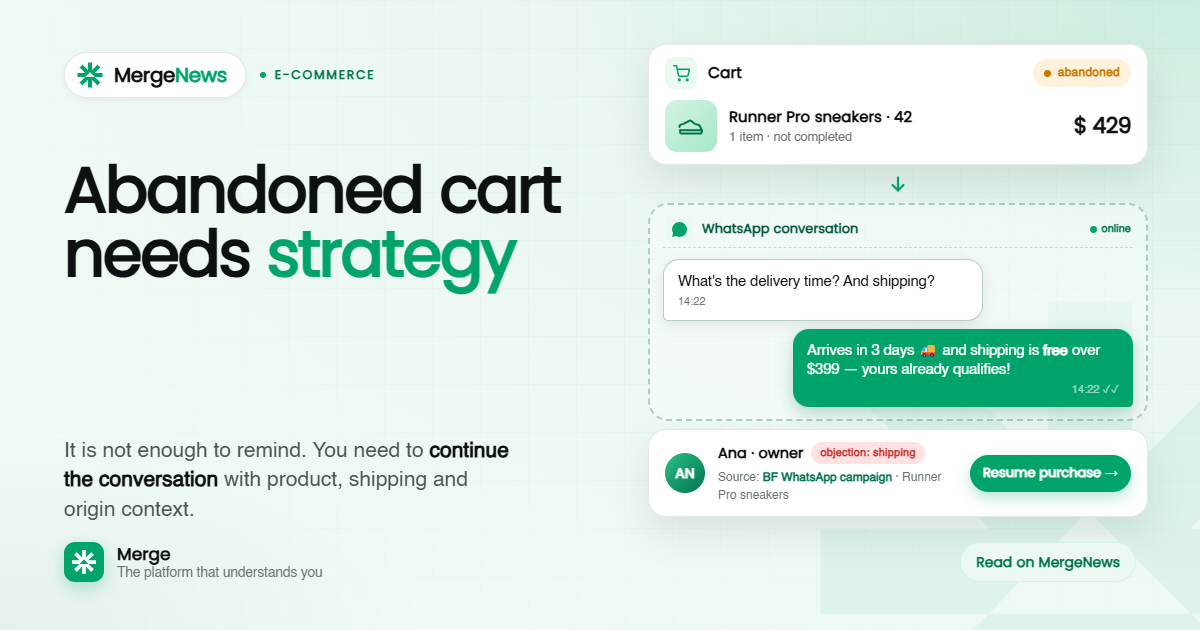
An abandoned cart isn't just forgetfulness. Often, the customer didn't finish the purchase because of a question about shipping, delivery time, payment method, trust, exchanges, sizing, compatibility, or price. When cart recovery turns into just an automated "you forgot something" message, the company treats as a distraction what might actually have been an objection.
That's why WhatsApp has gained ground in sales recovery. Unlike email or SMS, it allows for actual conversation. The customer can reply, ask a question, negotiate, explain why they backed out, and finish the purchase on the same channel where they got the reminder.
But that only works well when the company has context.
Get MergeNews in your inbox
Every week, news about WhatsApp, AI, CRM, and sales automation to turn customer service into sales.
Knowing that someone abandoned a cart isn't enough. Ideally, you'd know which product was in the cart, where the customer came from, whether they've bought before, what the last conversation was about, which campaign drove that visit, and whether someone owns following up. Without that, automation turns into noise — and that's exactly the kind of gap a minimum CRM setup for e-commerce should close.
An automated message can recover part of the lost sales, but it can also annoy customers if it's generic, repeated, or sent at the wrong time. The challenge isn't just sending the reminder. It's building a smart way to pick the conversation back up.
WhatsApp lets cart recovery stop being a notification and become actual customer service. A good flow can start with automation, understand the interest, identify the objection, and bring in a person when the case calls for a human decision — the same balance that separates automation with real context from just another bot replying fast.
That changes the logic of the operation. The company doesn't have to choose between bot or human. It needs to use automation so it doesn't lose timing, and use human staff wherever there's doubt, objection, or a real opportunity.
An abandoned cart is a hot signal. The customer already showed intent. When that signal lands in an operation with no CRM, it becomes just another lost conversation — and money the e-commerce business leaves behind. It's a problem that agencies handling traffic for stores, like Shopify agencies, feel firsthand: the campaign drives the click, but customer service decides whether it turns into a sale.
Practical action for businesses
- Send recovery messages with product, delivery time, and cart context — not just a generic message.
- Ask why the customer backed out before offering a discount.
- Route replies with doubts or objections to human customer service.
- Log the customer's source, campaign, product, and conversation history in the CRM.
- Measure recovery by stage to know whether the issue is price, shipping, trust, or customer service.