

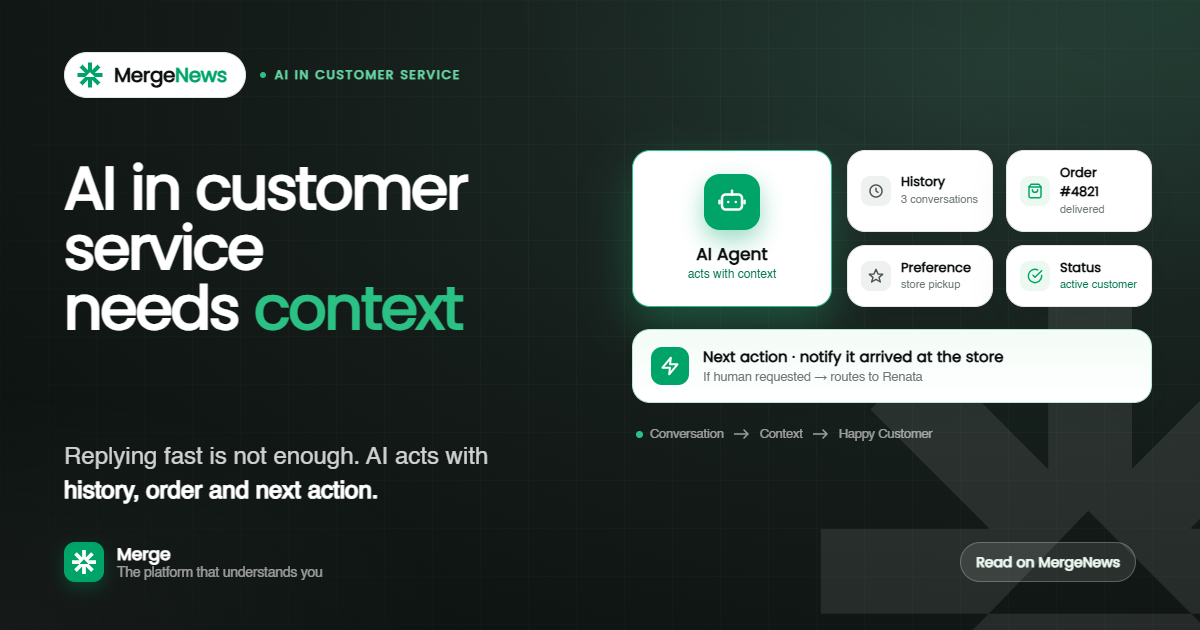
The next phase of AI in customer service won't be won by whoever writes the prettiest reply.
Replying fast got easier. Any company can plug in an AI to greet customers, explain something, answer FAQs, and look available 24 hours a day. The problem is that customer service doesn't end at the reply.
Customers want things resolved. They want to know their order status. They want to reschedule a conversation. They want to talk to the right person. They want to understand a charge. They want to recover a purchase. They want to continue a negotiation. They don't want to repeat everything they already explained last week.
Get MergeNews in your inbox
Every week, news about WhatsApp, AI, CRM, and sales automation to turn customer service into sales.
That's where a lot of chatbots fail. Without context, AI becomes a layer of text sitting on top of a disorganized operation. It replies, but it doesn't know. It converses, but it doesn't decide. It looks useful, but it doesn't change the business outcome.
Recent moves in the market point another way: companies are already positioning AI agents connected to business data — catalog, inventory, orders, CRM, history, preferences, customer service, and channels like WhatsApp and SMS.
That's the difference between a chatbot and an operational agent. A chatbot answers a question. An agent with context understands the situation, checks data, follows rules, triggers workflows, logs information, and hands off to a human when needed — the same kind of layer already showing up in platforms that treat AI on WhatsApp as part of the operation, not a showcase feature.
For companies selling on WhatsApp, this changes the priority. Before asking "which AI should we use?", the right question is: "where does our customer context actually live?"
If history is scattered across phones, spreadsheets, unowned conversations, and disconnected tools, the AI will have little to work with. It might look smart, but it'll be limited by the mess underneath — the same reason it's worth structuring a WhatsApp CRM before automating anything.
Companies that organize CRM, pipeline, customer service, campaigns, and history before automating build a real advantage. Because the AI ends up operating on live data, not assumptions — the same criterion that should weigh into choosing a WhatsApp platform with CRM, campaigns and AI.
Practical action for businesses
- Organize history, CRM, orders, and customer service before automating with AI.
- Define which data the AI can access and which actions it can take.
- Set clear rules for when a conversation should go to a person.
- Review replies and outcomes to measure whether the AI resolved things or just answered.
- Integrate WhatsApp, CRM, and automation so context follows the customer.