

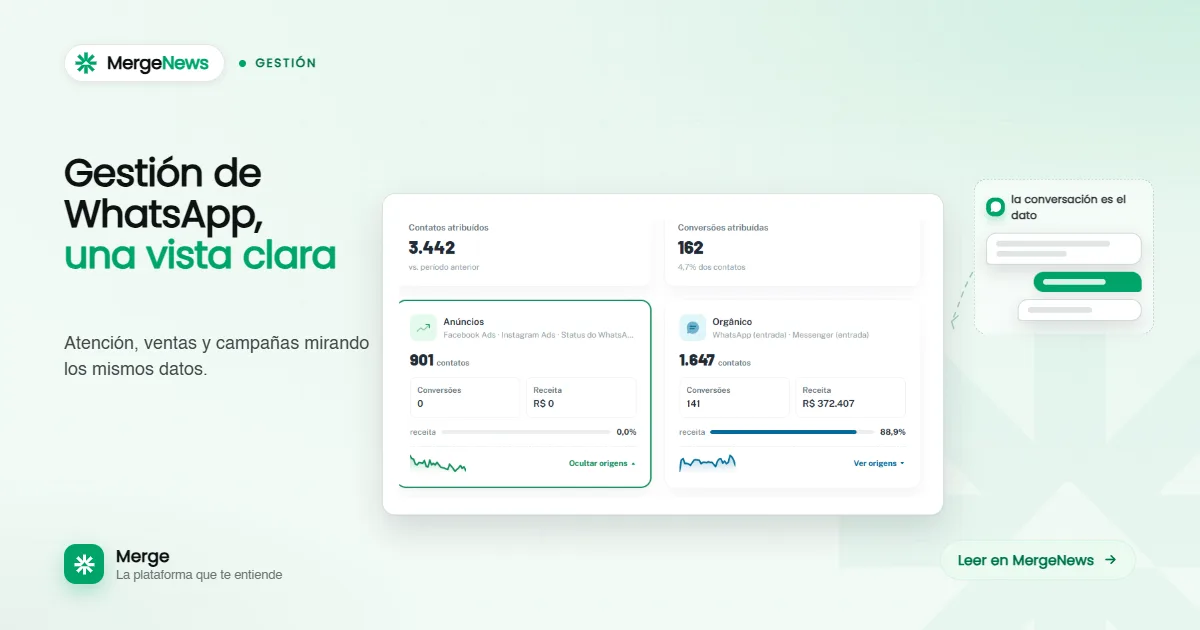
A manager who can't see WhatsApp can't see the whole company.
That may sound like an exaggeration, but in a lot of businesses, it's already true.
Today, WhatsApp carries sales, support, finance, after-sales, billing, scheduling, onboarding, relationship management, campaigns, and everyday customer service. A significant part of the operation happens right there.
Get MergeNews in your inbox
Every week, news about WhatsApp, AI, CRM, and sales automation to turn customer service into sales.
The problem is that, in a lot of companies, WhatsApp is still treated as an informal channel.
The customer sends a message, someone replies, the matter moves forward. But management can't clearly see how many opportunities exist, which conversations have stalled, who owns what, how long the customer waited, why a case was closed, or where a deal got stuck.
With no organization, WhatsApp becomes an invisible operation.
And an invisible operation can't be managed.
The manager ends up relying on manual questions: "Who's handling this customer?", "Did anyone reply?", "Was this order resolved?", "Why didn't this lead close?", "Which campaign generated this conversation?", "Is this a support, finance, or sales issue?"
When the answer is scattered across conversations, groups, and individual memory, the company loses decision-making speed.
WhatsApp brought companies closer to customers, but closeness with no structure turns into noise.
Organizing WhatsApp doesn't mean bureaucratizing the conversation. It means giving shape to what already happens every day.
That starts with separating areas: sales, support, finance, after-sales, onboarding, customer service, campaigns. Then defining owners, queues, tags, closing reasons, priorities, deadlines, and reports.
When the operation is organized, the manager stops looking only at message volume and starts tracking better metrics: first response time, resolution time, conversations by department, open opportunities, assisted sales, loss reasons, lead sources, campaigns that generated a response, and bottlenecks in service.
This shift matters because WhatsApp stopped being just a contact channel. It became a source of operational data.
In Opinion Box's 2026 WhatsApp in Brazil survey, 77% of respondents say they regularly talk to brands and companies on WhatsApp. That means a large part of the customer experience already runs through it.
If a company doesn't organize this channel, it loses information exactly where the customer engages the most.
The same goes for artificial intelligence.
AI can help summarize, classify, route, and answer repetitive requests. But without history and process, it operates in the dark. With an organized operation, AI works with better data and delivers more value.
Merge's internal support data shows that operational maturity on WhatsApp spans several layers: AI, connectivity, messaging, cart, ERP, departments, permissions, reports, templates, tags, and Meta incidents. In other words, companies that sell and provide support on WhatsApp don't just need an inbox. They need management infrastructure.
This is where Merge comes in.
The goal is to centralize customer service, CRM, campaigns, automation, history, and AI into an operation the manager can actually keep track of. The customer keeps talking on WhatsApp, but the company starts responding with process, context, and visibility.
Improving company management doesn't necessarily start with a massive transformation.
Sometimes it starts with a simple decision: stop treating WhatsApp as loose conversation and start treating it as a core part of the operation.
Practical action for managers
- Map which areas of the company use WhatsApp today.
- Sort customer service by department and type of request.
- Assign owners and deadlines to relevant conversations.
- Measure response time, resolution, conversion, and closing reason.
- Connect WhatsApp, CRM, campaigns, and AI into a single view.
Sources
- Opinion Box, 2026 WhatsApp in Brazil Survey
- Internal source: aggregated data from Merge support, June/July 2026. Used without naming customers.