

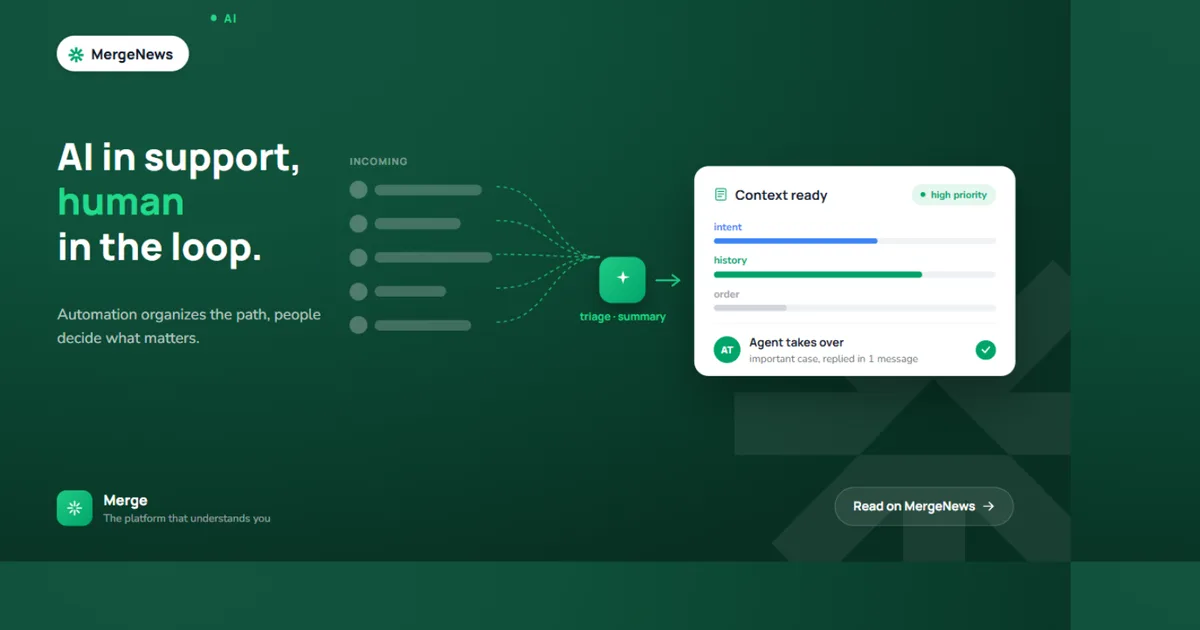
The conversation about AI in customer service still tends to land on the wrong question: will AI replace humans?
For most companies, that's not the question that matters.
The more useful question is: which tasks are eating up the team's time without actually requiring human judgment?
Get MergeNews in your inbox
Every week, news about WhatsApp, AI, CRM, and sales automation to turn customer service into sales.
Customer service and sales carry a heavy load of repetitive work: answering frequent questions, collecting data, classifying intent, routing to a department, summarizing history, applying tags, updating information, remembering to follow up, and organizing context.
These tasks need to get done. But not all of them need to be done manually, by a person.
Recent Salesforce data shows just how big the problem is. In 2026, customer service agents spend only 39% of their time actually helping customers. Sales reps spend only 30% of their day selling. The rest gets lost to admin work, prep, hunting for information, and other support tasks.
That's the space where AI can create real value.
Not as a full replacement. As operational relief.
On WhatsApp, this matters even more because the channel mixes everything together. The same incoming message could be a simple question, a complaint, a price request, a delivery issue, campaign curiosity, a support request, a negotiation, or an after-sales matter.
With no triage, everything lands on the human team the same way.
The result is predictable: an overloaded agent, a rep replying to a curious browser with no intent to buy, a hot lead left waiting, incomplete history, and a manager with no real visibility into the operation's actual volume.
A well-configured AI can sort these requests out much better.
It can answer simple questions, collect initial data, identify intent, suggest a reply, summarize the previous interaction, route to the right department, and hand off to a human when the case calls for sensitivity.
But there's a critical catch: AI needs context.
AI with no history gives generic answers. AI with no boundaries can keep pushing when it should have handed off. AI with no metrics looks like it's working, but nobody actually knows if it resolved anything, annoyed the customer, converted the lead, or just pushed the problem further down the road.
Merge's internal support data backs this up. Across two consecutive monthly periods, AI was the topic with the highest share among the customers served: it came up in 80% of active groups in the first period and 74% in the second, staying the leading topic in support conversations.
That shows the demand for AI is already real. But it also shows that adoption needs to come with configuration, review, governance, human handoff, and ongoing monitoring.
The market is heading the same way. Salesforce reported that AI agent adoption among service organizations rose from 39% in 2025 to 66% in 2026. According to the company, 70% of organizations that adopted agents saw measurable value within 60 days.
The point isn't putting AI on everything. It's designing a hybrid operation.
AI handles the repetitive, the classifiable, and the preparatory. Humans handle negotiation, relationship-building, conflict, exceptions, and decisions that require judgment.
For this to work, the company needs to map its main types of demand:
- What are the 20 most frequent questions?
- Which ones are simple questions?
- Which ones are sales-related?
- Which ones are sensitive?
- When should the AI hand off?
- How do you measure whether it actually got resolved?
At Merge, this logic connects to customer service, CRM, tags, departments, automations, and history. AI doesn't operate in isolation — it works on top of an organized operation.
The mature promise of AI on WhatsApp isn't "you'll never need agents again."
The real promise is better than that: cutting repetitive workload, improving routing, preserving context, and freeing up the human team to serve and sell at a higher level.
Practical action for businesses
- List the 20 most frequent customer service questions.
- Separate simple questions, sales-related questions, and sensitive cases.
- Set clear rules for handing off to a human.
- Measure conversations started, resolved, transferred, and converted.
- Use AI to prep the human, not to hide the human.
Sources
- Salesforce, AI service agent adoption
- Salesforce, AI & App Development Trends 2026
- Internal source: aggregated data from Merge support, June/July 2026. Used without naming customers.