

Plenty of sales teams already sell on WhatsApp every single day.
The lead comes in through an ad, clicks the button on the website, replies to a campaign, asks for a price, negotiates terms, sends a question, gets a proposal, and comes back days later. It all happens inside the conversation.
The problem is that management often tries to track that sale somewhere else entirely.
Get MergeNews in your inbox
Every week, news about WhatsApp, AI, CRM, and sales automation to turn customer service into sales.
The rep talks on WhatsApp, but the CRM stays incomplete. The objection shows up in a voice note, but it never becomes a record. The proposal goes out, but the stage doesn't move. The customer asks for a callback, but the follow-up depends on the rep remembering. The deal progresses, but the manager only finds out when they ask.
This is where WhatsApp creates a dangerous illusion: a lot of activity looks like progress.
But a message isn't a sale. A reply isn't an opportunity. A conversation isn't a pipeline.
To sell better on WhatsApp, the team needs to turn customer conversations into a sales process.
That starts with a simple question: if the sale happens on WhatsApp, can the pipeline actually see WhatsApp?
If the answer is no, the company has a blind spot.
The lead may have come from a paid campaign, but nobody knows which ad generated the conversation. The customer may have shown interest, but never entered a pipeline stage. The rep may have nailed the approach, but the company never learns from it. The deal may have been lost, but the reason got lost inside the conversation too.
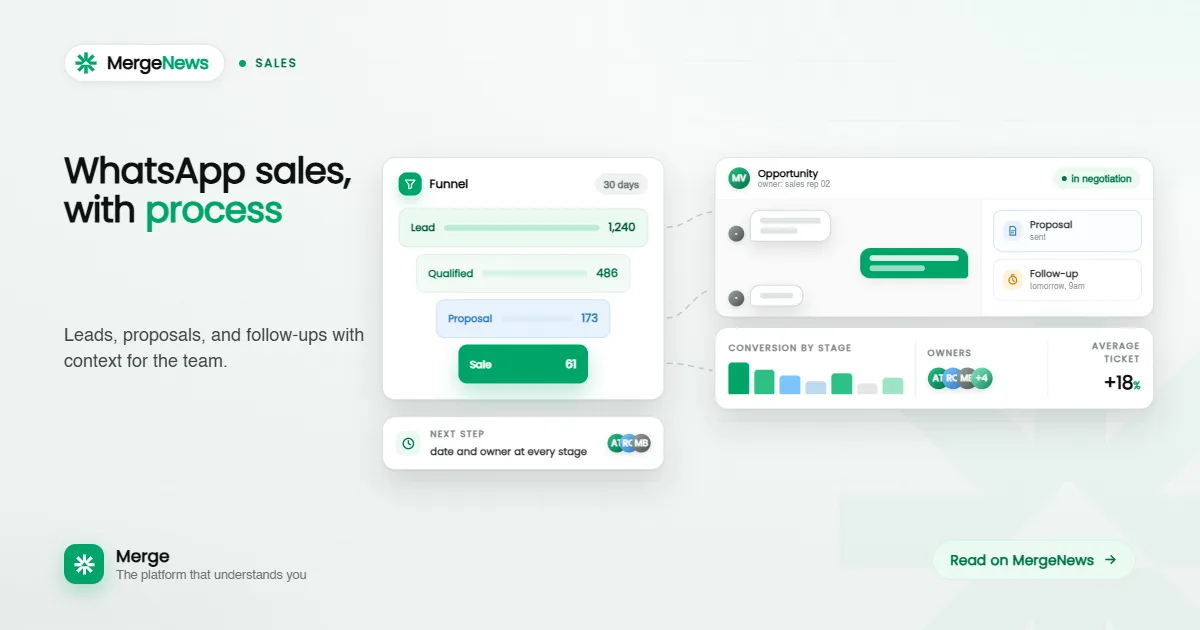
Sales organization on WhatsApp requires a few basic elements: lead source, owner, stage, next step, potential value, tags, history, loss reason, and follow-up date.
Without that, the team works in the dark.
With it, management can start seeing exactly where the pipeline is stalling: lead quality, slow response times, missing follow-up, the proposal itself, negotiation, or after-hours coverage.
Salesforce data helps size up this problem. In its 2026 AI and app development trends report, the company found that sales reps spend only 30% of their day actually selling. The rest goes to admin work, prep, updating systems, hunting for information, and other support tasks.
That maps directly onto the day-to-day of selling on WhatsApp.
When a rep has to re-read history, hunt for information, manually update the CRM, remember to follow up, and classify conversations on their own, they burn energy on operational work instead of selling.
Artificial intelligence can help, but it doesn't replace process.
A well-configured AI can summarize conversations, classify intent, suggest next steps, spot frequent questions, apply tags, and get the rep ready for the next interaction. It can also separate the curious from the genuinely interested, especially when campaigns drive a high volume of messages.
But AI only works well when there's context and rules behind it.
It needs to know when to respond, when to hand off, when to log something, and when to let the human take over. In sales, negotiation, exceptions, complex objections, and relationship-building still require human judgment.
The best use of AI isn't hiding the salesperson. It's taking the administrative weight off them so they can sell better.
This is where Merge comes in: connecting WhatsApp, customer service, CRM, campaigns, automation, and AI. The goal isn't just replying to messages. It's turning every conversation into an organized opportunity, with an owner, context, and a next step.
Because once WhatsApp becomes part of the pipeline, the team stops relying on individual memory and starts selling with process.
Practical action for sales teams
- Define clear sales stages for conversations coming from WhatsApp.
- Log source, owner, next step, and loss reason.
- Build a follow-up cadence inside the CRM.
- Use tags for intent, objection, product, campaign, and priority.
- Apply AI to summarize, classify, and prep the rep.
Sources
- Salesforce, AI & App Development Trends 2026
- Internal source: Merge's internal data and demo talking points on AI, CRM, history, and pipeline.