

Parents, students, and guardians don't necessarily want yet another app. In practice, they want clear information, quick answers, and a way to talk to the institution through the channel they already use every day.
That's why WhatsApp has become part of the routine at schools, course providers, colleges, mentoring programs, and other education businesses.
It's used to send event reminders, confirm schedules, flag changes, answer questions, discuss enrollment, share documents, guide payments, track absences, handle technical support, and maintain the relationship.
Get MergeNews in your inbox
Every week, news about WhatsApp, AI, CRM, and sales automation to turn customer service into sales.
The upside is obvious: closer communication and less friction.
But the downside shows up when everything lands in the same place.
A group that starts as an announcement channel turns into a space for one-on-one billing conversations. An academic question gets mixed in with a financial matter. A complaint shows up in the same thread as a general announcement. A guardian sends a message outside business hours. One student gets different information than another. Staff replies, but afterward nobody knows where the history went.
The problem isn't using WhatsApp in education. The problem is using WhatsApp with no operating rules.
Studies on WhatsApp groups between teachers and parents show exactly this tension. The channel can bring families and schools closer, but constant availability, the conversational format, and the public exposure of the group also create boundaries, noise, and overload. Communication works best when there's a clear definition of who's responsible, what hours apply, what kind of content belongs there, and how things get routed.
Another important point: recurring communication with families can improve engagement when there's cadence and a system behind it. A J-PAL study on messaging parents in São Paulo found improvements in parental involvement and education outcomes. The study isn't specifically about WhatsApp, but it backs the broader point: structured communication with guardians matters.
For educational institutions, WhatsApp needs to stop being just a busy group and start being a relationship operation.
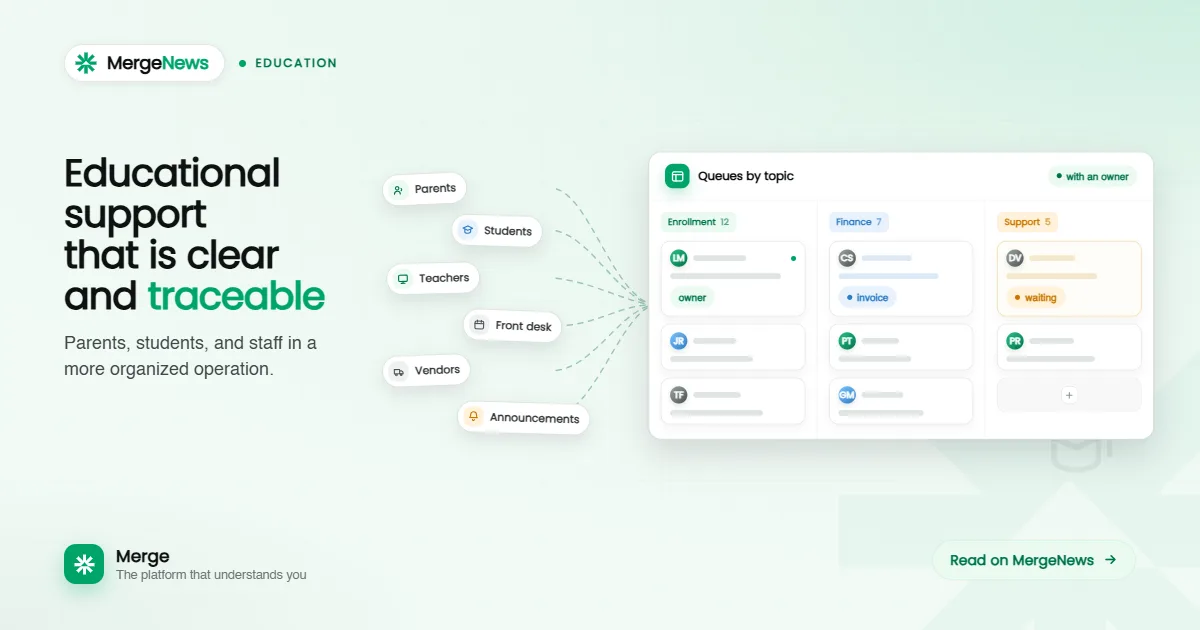
That starts with separating types of requests.
General announcements shouldn't compete with individual questions. Financial matters shouldn't get lost in academic conversations. Document requests need an owner. Sensitive incidents need careful handling and a paper trail. Technical support needs a queue. Enrollment and re-enrollment need sales-style follow-up.
When everything gets mixed together, the institution works hard but controls very little.
A minimal structure already changes the picture: classes, courses, students, guardians, class schedules, per-contact history, and reports. Parents and students keep talking through a familiar channel, but the institution starts operating with real organization.
Artificial intelligence can help too, as long as it's well designed.
An AI can answer frequent questions about schedules, documents, the calendar, enrollment, duplicate documents, class links, and basic guidance. It can also flag when a case needs a human: a complaint, a sensitive academic situation, a financial negotiation, a student issue, or anything that involves trust.
The key point is not turning AI into a barrier. It should take the predictable load off and route what needs a person to the right place, faster.
In education, communication isn't just about efficiency. It's about trust.
That's why WhatsApp needs to be fast without being messy, close without being invasive, and automated without losing the human touch.
This is where Merge can help educational institutions: organizing service, history, departments, CRM, and automations in one place. The institution stays reachable on WhatsApp, but stops depending on scattered groups and individual memory.
Practical action for educational institutions
- Separate channels for announcements, individual support, finance, technical support, and enrollment.
- Define hours and owners for each type of request.
- Build history per contact, not just per group.
- Use tags for topics like enrollment, re-enrollment, finance, support, academics, and documentation.
- Automate repetitive questions and hand sensitive cases off to a human.
Sources
- Wasserman and Zwebner, study on teacher-parent communication via WhatsApp
- Teaching and Teacher Education, study on WhatsApp groups between parents and teachers
- J-PAL, study on messaging parents in São Paulo