

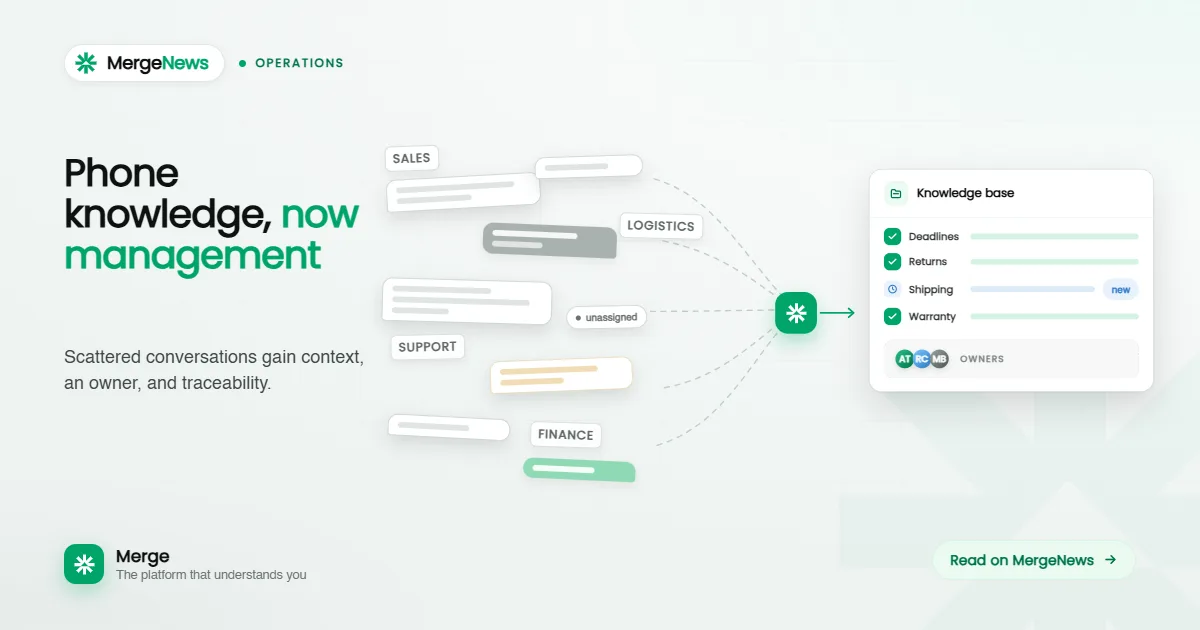
WhatsApp solved a real problem for companies: it brought people, customers, salespeople, support, finance, managers, and operations together on a channel everyone already knows how to use.
That's why it spread so fast inside companies. It doesn't require long training. It doesn't feel like a system. It creates no friction for the customer. The message arrives, someone replies, the issue moves forward.
At first, this looks like pure upside. The team resolves things fast, the customer likes the closeness, and management feels the operation is alive.
Get MergeNews in your inbox
Every week, news about WhatsApp, AI, CRM, and sales automation to turn customer service into sales.
But there's a hidden cost behind that speed: the company's knowledge starts getting trapped in conversations, groups, voice notes, screenshots, and individual memory.
The quote got agreed on WhatsApp. The customer's objection came up on WhatsApp. The recurring question got answered on WhatsApp. The deadline got renegotiated on WhatsApp. The reason for the lost deal got mentioned on WhatsApp. The support issue got explained on WhatsApp.
But if none of that turns into organized history, the company doesn't learn from it.
The customer comes back days later and has to repeat the context. The salesperson remembers some cases but forgets others. The manager keeps asking "where do things stand?" because they can't see the operation. Support answers the same question over and over. The sale depends on whoever handled it remembering.
The problem isn't that the company uses WhatsApp. The problem is treating WhatsApp as just conversation, when it has already become infrastructure for service, sales, and management.
Market data backs this up. Opinion Box's 2026 WhatsApp in Brazil survey found that 77% of respondents regularly talk to brands and companies on WhatsApp. The same study found that 37% say they leave the app open all day. In other words: the channel is already part of people's routine, whether they're a customer or an employee.
When the customer is there, the company needs to be there too. But just showing up isn't enough.
A mature operation needs to turn conversation into history, history into context, context into CRM, and CRM into management.
That means defining owners, departments, stages, tags, closing reasons, next steps, and metrics. It means knowing whether a conversation is a sale, a support case, a billing matter, after-sales, a campaign, a booking, or a relationship touchpoint. It means being able to look at WhatsApp and actually understand what's happening in the business.
This is also where artificial intelligence starts to make sense.
AI with no context turns into a generic reply. AI with history, process, and clear handoff rules can summarize conversations, classify requests, suggest next steps, route to the right department, and take repetitive tasks off the team's plate.
In Merge's internal support data, AI came up as the most recurring topic in two consecutive monthly periods: 219 conversations across 75 groups between June 7 and July 6, 2026, and 217 conversations across 65 groups in July. That shows something important: companies want to automate, but the real pain point isn't just "having AI." It's getting AI to operate with context, oversight, metrics, and a human handoff.
WhatsApp gave companies speed. Now they need structure.
Because when knowledge is scattered, management is blind. When history is organized, every conversation starts generating learning, control, and commercial opportunity.
That's Merge's role: helping companies turn WhatsApp into an organized layer of customer service, CRM, campaigns, and intelligence. Not to strip the conversation of its natural feel, but to make sure what happens there doesn't get lost.
Practical action for businesses
- Map where WhatsApp shows up across the operation: sales, support, finance, after-sales, campaigns, and relationships.
- Sort conversations by type, department, and priority.
- Assign an owner and a next step to every relevant conversation.
- Log history, closing reason, and sales stage.
- Use AI to summarize, classify, and prep the human — not to hide the human.
Sources
- Opinion Box, 2026 WhatsApp in Brazil Survey
- Internal source: aggregated data from Merge support, June/July 2026. Used without naming customers.