

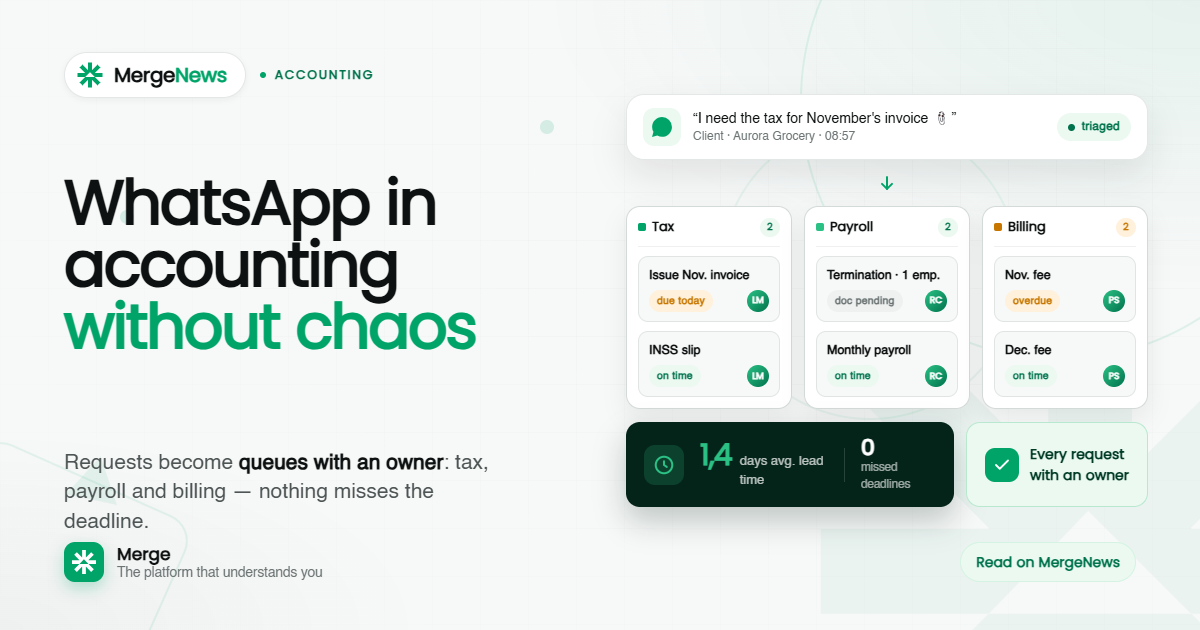
Few industries use WhatsApp as much as accounting firms.
A client sends an invoice. Then a tax question. Then asks about payroll. Then sends an onboarding document. Then follows up on a bill. Then sends a voice note. Then switches topics mid-conversation.
The problem isn't WhatsApp. The problem is all of that landing in the same place, with no queue, no owner, no priority, and no organized history.
Get MergeNews in your inbox
Every week, news about WhatsApp, AI, CRM, and sales automation to turn customer service into sales.
At many accounting firms, WhatsApp has become the client's main entry point. But the operation is still treated as an informal chat. That creates a dangerous tension: the client expects a fast reply, but the firm needs to handle deadlines, obligations, documents, reviews, and tasks that can't depend on whoever happened to answer remembering everything.
When customer service is scattered across phones, group chats, and loose conversations, the signs of loss show up fast. A request goes unassigned. An important document gets lost. A tax deadline depends on a message that got buried. A client repeats the same information to different people. An employee leaves the firm and takes part of the history with them.
For accounting firms, organizing WhatsApp with a CRM isn't a luxury. It's operational efficiency.
The firm needs to know who asked for what, when they asked, who's responsible, what the status is, which documents are missing, and what's already been discussed. It also needs to separate customer service, sales, support, billing, and technical requests. Without that, the channel that's supposed to bring the client closer starts creating more rework — the same kind of bottleneck that shows up when nobody knows what to measure in a WhatsApp sales operation.
The opportunity is to turn WhatsApp into an organized relationship layer. That means centralized history, work distribution, tags, a request pipeline, useful automation, human handoff, and management visibility. Not to replace the accountant, but to take off the team's plate what actually needs to live in the process — which also keeps WhatsApp customer service from depending on whoever happens to be on duty at that moment.
The client doesn't care whether their question came in through WhatsApp, email, or a call. They want to feel like the firm knows who they are, what they need, and where their request stands — the same principle behind treating customer relationships as a company asset, not the informal memory of whoever answered.
Practical action for businesses
- Create separate queues for tax, accounting, payroll, billing, and sales.
- Assign an owner to every request received on WhatsApp.
- Use tags or statuses to tell apart questions, pending documents, deadlines, and deliverables.
- Centralize history so information doesn't stay stuck on one person's phone.
- Track volume, response time, and recurring requests to improve the process.