

WhatsApp is moving beyond messaging between companies and customers.
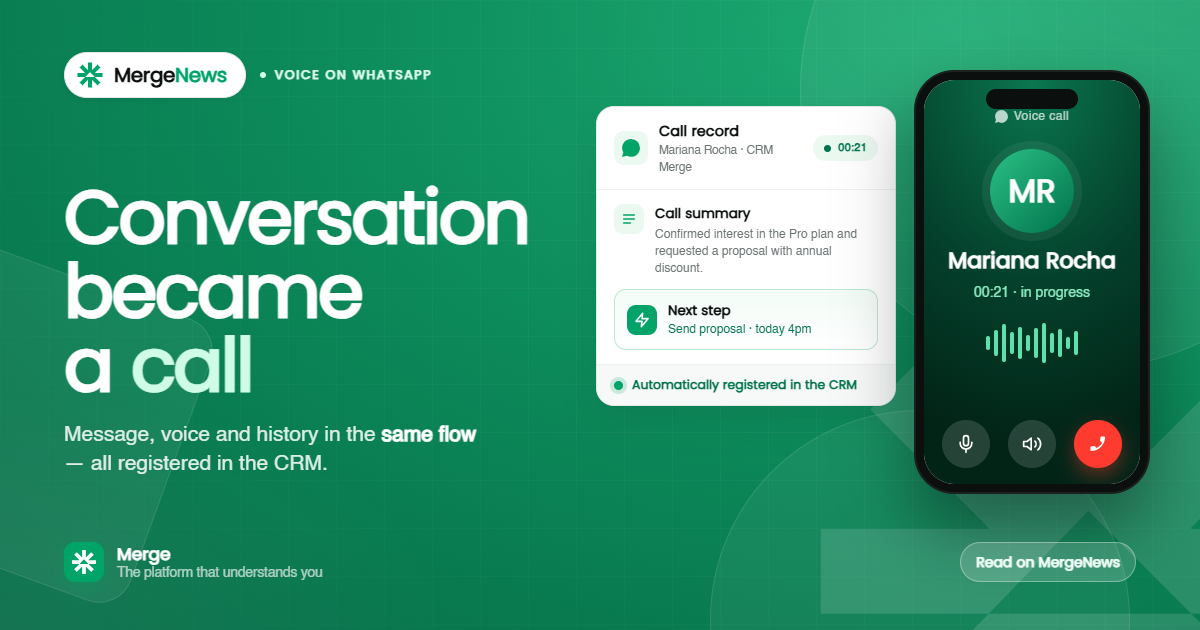
Meta launched the WhatsApp Business Calling API, a feature that lets companies place and receive voice calls inside the WhatsApp Business Platform experience. In practice, a conversation can start as a message and escalate to a call in the same environment, without forcing the customer to switch channels.
This move matters because many sales journeys don't end well with text alone. A lead might need to clear up a question before closing. A customer might have an urgent problem. A billing issue might require confirmation. Technical support might need a real-time explanation. A negotiation might depend on trust, timing, and context.
Get MergeNews in your inbox
Every week, news about WhatsApp, AI, CRM, and sales automation to turn customer service into sales.
Before, larger companies using the WhatsApp Business API had an easier time automating messages, organizing customer service, and integrating CRM, but voice calling still sat outside the main journey. With the Calling API, Meta brings messaging and voice closer together inside the same operational flow.
This doesn't mean every conversation should turn into a call. It means the company now has one more layer to resolve cases where text, recorded audio, or automation aren't enough.
The most relevant point isn't the call itself. It's the context. When the call originates from a WhatsApp conversation, the company can understand who the customer is, what the last interaction was, what stage of the journey they're in, and why that call makes sense — the same reasoning behind running WhatsApp CRM as a journey, not a loose messaging inbox. That changes the quality of the service and the sale.
It also raises the operation's responsibility. If a company starts receiving or initiating calls on WhatsApp, it needs to set rules: when to call, who can call, at what hours, with what permission, how to log the call summary, and what the next step should be after the conversation — decisions that, in practice, are part of choosing a WhatsApp platform with CRM, campaigns and AI that's ready for this kind of feature.
For sales and customer service, the trend is clear. WhatsApp is moving past being just a messaging channel and becoming a relationship layer that connects text, media, automation, AI, and voice to the operation.
Companies that treat this as improvisation end up with more complexity. Companies that treat it as a process gain more control — and can even keep automated WhatsApp messages consistent with whatever was agreed on during a call.
Practical action for businesses
- Define which situations should turn a conversation into a call.
- Get consent before starting calls the company initiates.
- Log the summary and next step after every call.
- Connect calls, history, and CRM so no context gets lost.
- Track volume, timing, ownership, and outcome for every call.