

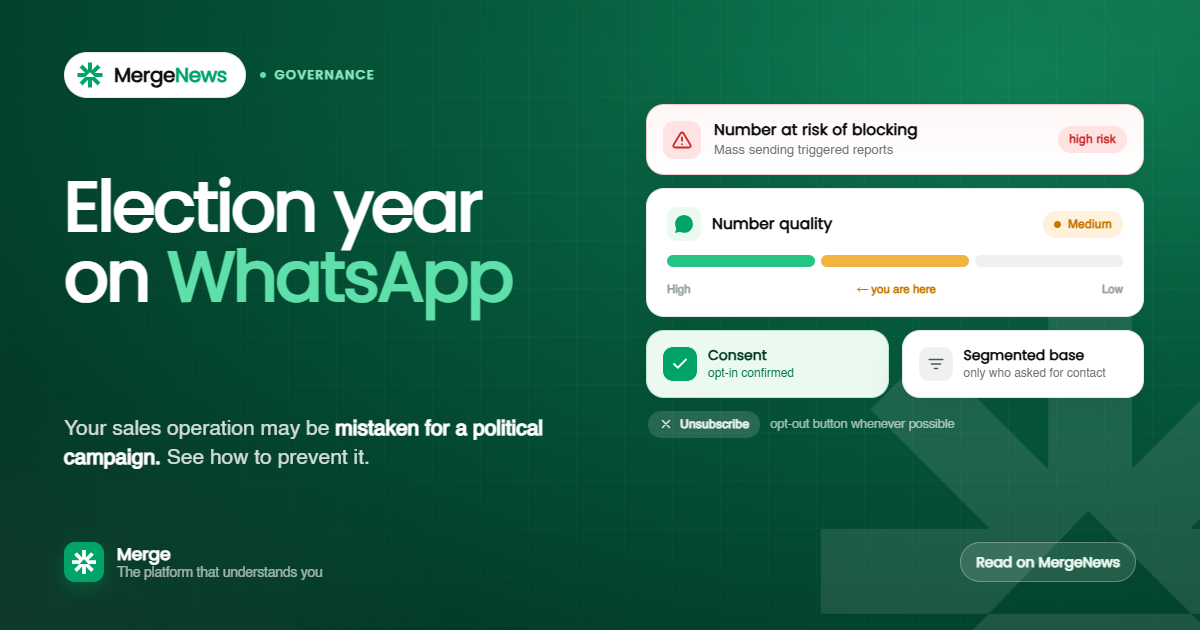
In election years, WhatsApp gets more sensitive. Not just for candidates, parties, and campaigns. Also for companies that use the channel as their main way to sell, support customers, and build relationships.
The risk for an ordinary company isn't necessarily running a political campaign. The risk is operating in a way that looks like a political campaign to users, moderation systems, or Meta itself.
That can happen when a company uses cold lists, old contacts, generic messages, repeated blasts, contacts with no consent, or communications mixed with political opinion. Even without asking for a vote, this kind of behavior can trigger blocks, reports, and a drop in number quality.
For anyone selling on WhatsApp, this isn't a technical detail. A limited, reported, or blocked number hurts open conversations, customer relationships, follow-ups, commercial history, and sales predictability.
Get MergeNews in your inbox
Every week, news about WhatsApp, AI, CRM, and sales automation to turn customer service into sales.
The core point is that Meta doesn't look at WhatsApp as just an app. It needs to protect the platform from abuse, spam, fraud, misinformation, and violations of local rules. That pressure rises during election periods.
In Brazil, the electoral courts have specific rules for online advertising, instant messaging, data use, unsubscribing, boosted content, and mass messaging. TSE Resolution No. 23.610 bans mass messaging without consent and creates obligations for application providers in certain contexts.
On top of that, the debate in Brazil over platform liability has gotten tougher in recent years. The Brazilian Supreme Court has set new standards for platform accountability over third-party content, and the electoral rules themselves cover situations where providers need to act on irregular content.
In practice, that creates a clear incentive: Meta tends to be stricter during sensitive periods to avoid regulatory, legal, and reputational problems in Brazil.
For the company, the problem is simple. If the commercial operation looks like spam, a political blast, or abuse of a contact list, WhatsApp can read that behavior as risk. And the customer isn't going to stop and analyze the brand's intent — they'll block, report, or ignore it.
This doesn't mean you need to stop selling on WhatsApp during election years. It means preparing for the season. Companies need to build their own opt-in lists, get consent for conversations, keep commercial and political contact lists separate, avoid cold blasts, make unsubscribing easy, segment messages, and log why each person received each communication. And for a real safeguard, move to a number on the official WhatsApp Business API.
In an election year, relying on WhatsApp alone to sell and support customers also becomes a risk. The channel stays strong, but it needs to be treated as critical infrastructure, not a free-for-all sending list — the same care that already applies to any WhatsApp campaign that can't turn into spam.
Companies that get this protect their number, improve the customer experience, and reduce the chance of being mistaken for something they're not. It's also one more reason to run commercial WhatsApp on WhatsApp CRM: logged source, consent, and history keep the commercial operation from being mistaken for improper blasting.
Practical action for businesses
- Ask existing customers to save your contact.
- Review your list's source before running any WhatsApp campaign.
- Keep commercial communication separate from any political, community, or election-related topic.
- Use segmented messages, with a clear reason for why the customer is receiving that contact.
- Make it easy to opt out, and honor blocks, unsubscribes, and complaints.